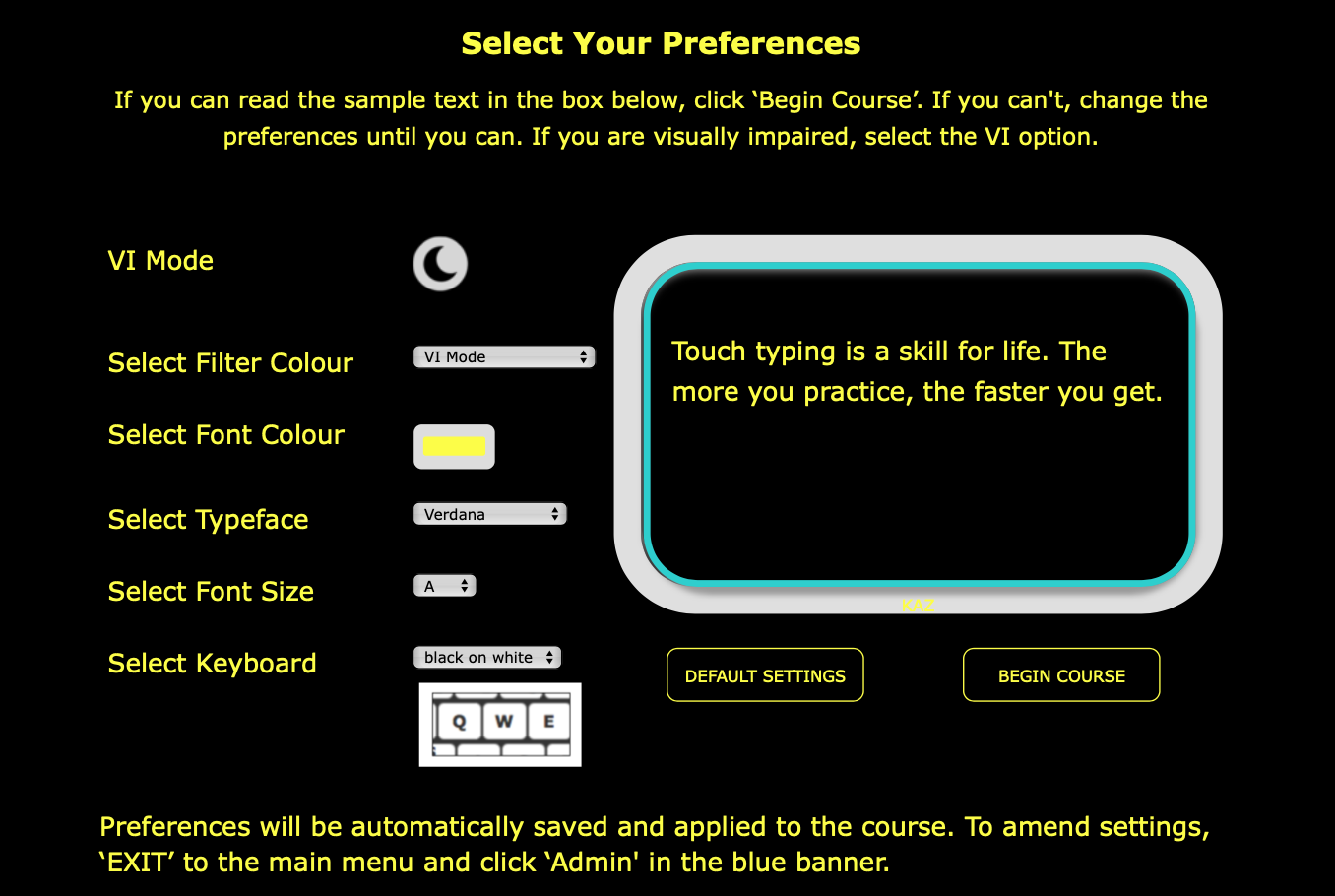
Touch Typing Software for the Visually Impaired & Blind
Specialised edition developed with advice and guidance from the
Thomas Pocklington Trust
Compatible with:
JAWS and other screen readers
Dolphin SuperNova and other magnification software/hardware
Google and other captioning software
Learning to touch type is considered one of the most beneficial skills for visually impaired and blind individuals. This is because it allows them to transfer their thoughts easily and automatically onto a screen. It provides them with an invaluable tool and asset for independent working and communicating.
Learning to touch type at any age can dramatically boost confidence, self-belief and independence. However, teaching learners with visual impairment at an early age can drastically transform their experience whilst at school and in FE/HE. It puts them on a more even standing with their sighted peers and opens doors to new career opportunities.
Achieving muscle memory and automaticity when touch typing increases efficiency and productivity. However, most importantly, it frees the conscious mind to concentrate on planning, composing, processing and editing, greatly improving the quality of the work produced.
The KAZ Course
The KAZ course is a tutorial and is designed to be used independently or with minimum supervision. However, a structured lesson plan is available in Administrators’ admin-panels should they wish to teach the course during lessons.
The course consists of five modules:
Module 1– Flying Start - explains how the course works, teaches the home-row keys, correct posture whilst sitting at the keyboard, and explains the meaning, causes, signs, symptoms and preventative measures for Repetitive Strain Injury.
Module 2– The Basics - teaches the A-Z keys using KAZ’s five scientifically structured and trademarked phrases.
Module 3– Just Do It - offers additional exercises and challenge modules to help develop ‘muscle memory’, automaticity and help ingrain spelling.
Module 4– And The Rest - teaches punctuation and the number keys.
Module 5– SpeedBuilder - offers daily practice to increase speed and accuracy.
Amor Estranho Amor (Love Strange Love, 1982): A Haunting, Forbidden Journey into Brazil’s Dark Past
Fifteen years earlier, a 12-year-old boy is sent to stay with his estranged mother, Anna (Vera Fischer), a stunning and ambitious courtesan who works in an opulent, isolated bordello. The establishment is run by the cold, calculating Madame (Xuxa Lopes). Initially, the boy is treated as an inconvenient secret, hidden away. But Anna, seeing a potential tool for her own advancement, decides to use her son’s growing, confused sexuality to please and bind her most powerful client, Senator Osmar.
Love Strange Love is perhaps most infamous for its casting. The young boy is played by Marcelo Ribeiro , who was 12 years old at the time of filming. He appears in several sexually charged scenes, including a long sequence where he is nude and caressed by Vera Fischer (then 30). Brazilian law and public sentiment were outraged. The film was heavily censored, banned for years, and only released in a severely cut version in 1982. The original, uncut reels were lost for decades, creating an aura of forbidden legend. A “restored” version surfaced in the 2000s, but the ethical questions surrounding its production remain deeply troubling.
Over a single, claustrophobic weekend, the boy is exposed to a world of adult rituals, voyeurism, and predatory desire. He becomes an unwitting participant in a dangerous game of seduction, power, and twisted maternal “love”—leading to a shattering climax that explains the haunted man he has become.
Graphic sexual situations involving an adult and an adolescent character (played by a minor), full nudity (child and adult), incestuous themes, psychological coercion, and political violence.
Love Strange Love is not entertainment . It is a cinematic experience akin to a wound. If you are interested in the intersection of politics, sexuality, and historical trauma, and you can stomach the profound ethical violation at its core, it is a uniquely haunting film. If you are triggered by child exploitation, incest themes, or coercive environments, avoid it completely.
Love Strange Love opens in 1937. Getúlio Vargas has just seized dictatorial power in Brazil. We meet a successful, now-aging politician whose past suddenly catches up with him. The film unspools in a series of lavish, disturbing flashbacks.
No ethical star rating. A necessary film? Perhaps. A watchable film? Barely. A forgotten film? Unfortunately, and for good reason, no.
Amor Estranho Amor -love Strange Love- -1982- English -
Amor Estranho Amor (Love Strange Love, 1982): A Haunting, Forbidden Journey into Brazil’s Dark Past
Fifteen years earlier, a 12-year-old boy is sent to stay with his estranged mother, Anna (Vera Fischer), a stunning and ambitious courtesan who works in an opulent, isolated bordello. The establishment is run by the cold, calculating Madame (Xuxa Lopes). Initially, the boy is treated as an inconvenient secret, hidden away. But Anna, seeing a potential tool for her own advancement, decides to use her son’s growing, confused sexuality to please and bind her most powerful client, Senator Osmar.
Love Strange Love is perhaps most infamous for its casting. The young boy is played by Marcelo Ribeiro , who was 12 years old at the time of filming. He appears in several sexually charged scenes, including a long sequence where he is nude and caressed by Vera Fischer (then 30). Brazilian law and public sentiment were outraged. The film was heavily censored, banned for years, and only released in a severely cut version in 1982. The original, uncut reels were lost for decades, creating an aura of forbidden legend. A “restored” version surfaced in the 2000s, but the ethical questions surrounding its production remain deeply troubling. Amor Estranho Amor -Love Strange Love- -1982- English
Over a single, claustrophobic weekend, the boy is exposed to a world of adult rituals, voyeurism, and predatory desire. He becomes an unwitting participant in a dangerous game of seduction, power, and twisted maternal “love”—leading to a shattering climax that explains the haunted man he has become.
Graphic sexual situations involving an adult and an adolescent character (played by a minor), full nudity (child and adult), incestuous themes, psychological coercion, and political violence. Amor Estranho Amor (Love Strange Love, 1982): A
Love Strange Love is not entertainment . It is a cinematic experience akin to a wound. If you are interested in the intersection of politics, sexuality, and historical trauma, and you can stomach the profound ethical violation at its core, it is a uniquely haunting film. If you are triggered by child exploitation, incest themes, or coercive environments, avoid it completely.
Love Strange Love opens in 1937. Getúlio Vargas has just seized dictatorial power in Brazil. We meet a successful, now-aging politician whose past suddenly catches up with him. The film unspools in a series of lavish, disturbing flashbacks. But Anna, seeing a potential tool for her
No ethical star rating. A necessary film? Perhaps. A watchable film? Barely. A forgotten film? Unfortunately, and for good reason, no.
Copyright KAZ Type Limited 2025. KAZ is a registered trade mark of KAZ Type Limited.
Developed by : STERNIC Pvt. Ltd.