Placeres: Prohibidos - 69 Relatos Eroticos - Luc...
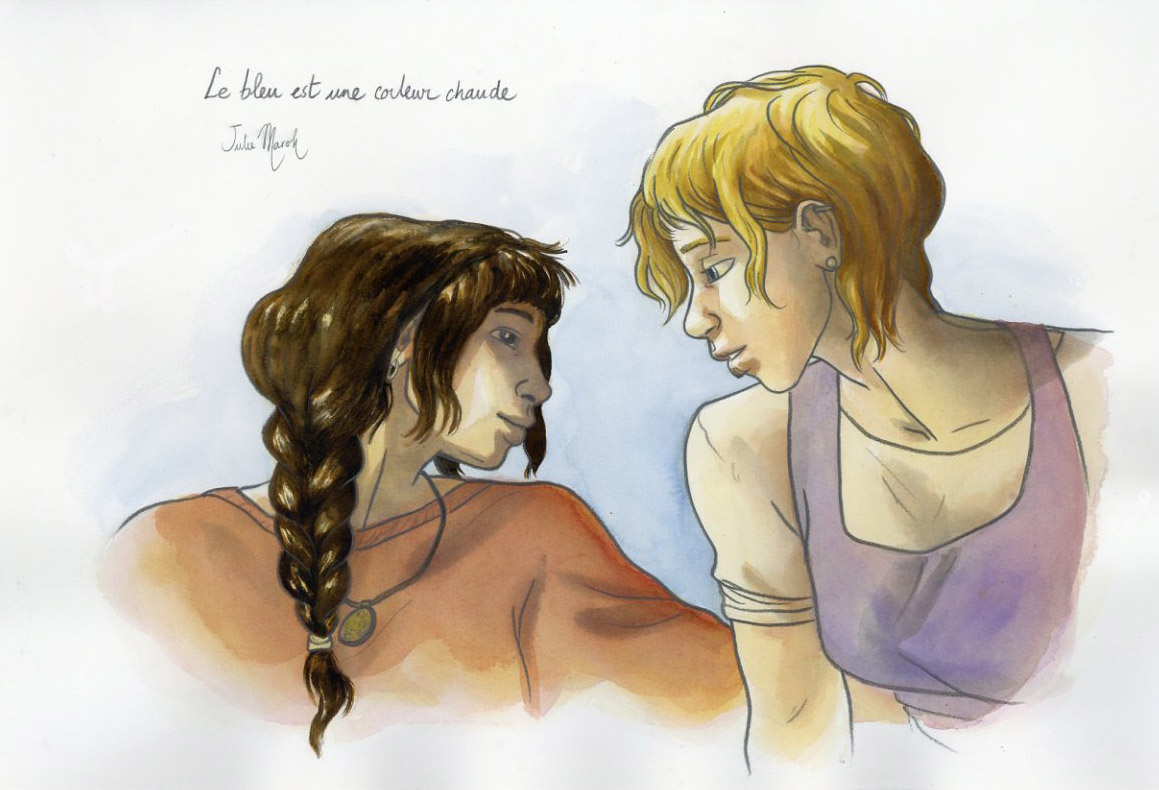
Le Bleu est une couleur chaude, illustration 14
Oeuvre originale.
Artiste : Jul Maroh
Dimensions (cm) : 30x40
Catégorie : Illustrations
Technique : Encre de couleur
Année : 2011
Étiquettes :
430 €
Lucía stands closest to Nicholson Baker in intellectual playfulness, but her Spanish voice is more direct, less self-consciously clever. The number 69 is not arbitrary. In publishing terms, it is a marketing hook. But literarily, it allows Lucía to cover the full spectrum of human erotic experience: from story #1 ("El primer beso" – The First Kiss, about teenage fumbling) to story #69 ("La última noche" – The Last Night, about a couple separating after 30 years, choosing one final, tender act).
Placeres Prohibidos (published originally in Spanish by Editorial Esencia) stands apart because it refuses the formula of the erotic "romance." There are no billionaire sadists, no naive heroines to be awakened. Instead, Lucía offers something rarer: . Structure as Seduction: The 69 Fragments The number 69 is not just provocation. The book is designed to be consumed in pieces—on a commute, before sleep, in stolen moments. Each story runs between two and five pages. This brevity is a literary weapon. Lucía practices what the French call la nouvelle érotique : the erotic short story, where every word must carry tension, and the ending often arrives like a held breath released.
The collection thus becomes a —starting with innocence, ending with farewell. Sex, in Lucía's world, is not just about pleasure. It is about time. About bodies aging. About the stories we tell ourselves to stay alive inside our own skin. Conclusion: A Worthy Addition to the Erotic Canon Placeres Prohibidos - 69 relatos eróticos is not for everyone. Readers seeking romantic happy endings or flowery descriptions of orgasms will be disappointed. Those seeking an unflinching, intelligent, and deeply human exploration of what people actually do, imagine, and regret in bedrooms, elevators, and parked cars—will find a masterwork. PLACERES PROHIBIDOS - 69 relatos eroticos - Luc...
No adjectives like "velvety" or "throbbing." No metaphors about waves or storms. This creates a different kind of heat: the heat of the real, of awkward silences, of clothing that gets stuck on an elbow, of a laugh that interrupts an orgasm. The "69" Experience: A Sample of Recurring Motifs While I cannot reproduce full stories, a critical analysis reveals recurring scenarios across the collection:
Below is a comprehensive, original feature article written for this request. Introduction: The Anatomy of a Modern Bestseller In the sprawling ecosystem of 21st-century erotic literature—overshadowed for a decade by the commercial juggernaut of Fifty Shades of Grey —Spanish-language writers have quietly cultivated a more nuanced, literary, and psychologically complex tradition. At the heart of this renaissance sits Lucía Gutiérrez de la Vega’s Placeres Prohibidos: 69 relatos eróticos . Lucía stands closest to Nicholson Baker in intellectual
The title itself is a double entendre. "Placeres Prohibidos" (Forbidden Pleasures) promises transgression, while the number "69" is both a graphic reference to the sexual position and a nod to the collection's scope—sixty-nine discrete stories. The book is not a novel but a mosaic. Each fragment is a keyhole through which the reader spies on a different configuration of desire, power, and vulnerability. Lucía Gutiérrez de la Vega (often stylized as Luc.) is a Spanish journalist, writer, and scriptwriter known for her sharp, sober, yet evocative prose. Unlike many erotic authors who adopt pseudonyms to hide behind a veil of shame or marketing gimmicks, Lucía writes openly about sex as an extension of human psychology. Her background in journalism informs the book's structure: each story is a "report" from the front lines of intimacy, stripped of superfluous ornamentation.
Notably, Lucía avoids hardcore BDSM or illegal scenarios. Her "prohibited" is always consensual, adult, and psychologically coherent. Upon publication, Placeres Prohibidos received strong reviews in Spanish media like El País and La Vanguardia . Critics praised its lack of moralizing and its literary craft. One reviewer called it "the Rayuela of erotic fiction"—a reference to Cortázar's hopscotch novel that can be read in any order. But literarily, it allows Lucía to cover the
However, some feminist critics have raised questions. A few stories feature power imbalances (e.g., professor-student). Lucía's defense, articulated in interviews, is that she depicts fantasies, not prescriptions. "Erotic literature is the space where we can safely explore what we would never do in life," she told Jot Down magazine. | Work | Tone | Length | Psychological Depth | Explicit Rating | |-------|------|--------|----------------------|------------------| | Placeres Prohibidos (Lucía) | Realist, dry | 69 micro-stories | High | Explicit (4/5) | | Delta of Venus (Nin) | Lyrical, surreal | Novel-length | Medium | Explicit (4/5) | | Fifty Shades (James) | Romantic melodrama | Novel | Low | Moderate (3/5) | | The Fermata (Baker) | Comic, meta | Novel | High | Explicit (4/5) |
Votre panier est vide.
Lucía stands closest to Nicholson Baker in intellectual playfulness, but her Spanish voice is more direct, less self-consciously clever. The number 69 is not arbitrary. In publishing terms, it is a marketing hook. But literarily, it allows Lucía to cover the full spectrum of human erotic experience: from story #1 ("El primer beso" – The First Kiss, about teenage fumbling) to story #69 ("La última noche" – The Last Night, about a couple separating after 30 years, choosing one final, tender act).
Placeres Prohibidos (published originally in Spanish by Editorial Esencia) stands apart because it refuses the formula of the erotic "romance." There are no billionaire sadists, no naive heroines to be awakened. Instead, Lucía offers something rarer: . Structure as Seduction: The 69 Fragments The number 69 is not just provocation. The book is designed to be consumed in pieces—on a commute, before sleep, in stolen moments. Each story runs between two and five pages. This brevity is a literary weapon. Lucía practices what the French call la nouvelle érotique : the erotic short story, where every word must carry tension, and the ending often arrives like a held breath released.
The collection thus becomes a —starting with innocence, ending with farewell. Sex, in Lucía's world, is not just about pleasure. It is about time. About bodies aging. About the stories we tell ourselves to stay alive inside our own skin. Conclusion: A Worthy Addition to the Erotic Canon Placeres Prohibidos - 69 relatos eróticos is not for everyone. Readers seeking romantic happy endings or flowery descriptions of orgasms will be disappointed. Those seeking an unflinching, intelligent, and deeply human exploration of what people actually do, imagine, and regret in bedrooms, elevators, and parked cars—will find a masterwork.
No adjectives like "velvety" or "throbbing." No metaphors about waves or storms. This creates a different kind of heat: the heat of the real, of awkward silences, of clothing that gets stuck on an elbow, of a laugh that interrupts an orgasm. The "69" Experience: A Sample of Recurring Motifs While I cannot reproduce full stories, a critical analysis reveals recurring scenarios across the collection:
Below is a comprehensive, original feature article written for this request. Introduction: The Anatomy of a Modern Bestseller In the sprawling ecosystem of 21st-century erotic literature—overshadowed for a decade by the commercial juggernaut of Fifty Shades of Grey —Spanish-language writers have quietly cultivated a more nuanced, literary, and psychologically complex tradition. At the heart of this renaissance sits Lucía Gutiérrez de la Vega’s Placeres Prohibidos: 69 relatos eróticos .
The title itself is a double entendre. "Placeres Prohibidos" (Forbidden Pleasures) promises transgression, while the number "69" is both a graphic reference to the sexual position and a nod to the collection's scope—sixty-nine discrete stories. The book is not a novel but a mosaic. Each fragment is a keyhole through which the reader spies on a different configuration of desire, power, and vulnerability. Lucía Gutiérrez de la Vega (often stylized as Luc.) is a Spanish journalist, writer, and scriptwriter known for her sharp, sober, yet evocative prose. Unlike many erotic authors who adopt pseudonyms to hide behind a veil of shame or marketing gimmicks, Lucía writes openly about sex as an extension of human psychology. Her background in journalism informs the book's structure: each story is a "report" from the front lines of intimacy, stripped of superfluous ornamentation.
Notably, Lucía avoids hardcore BDSM or illegal scenarios. Her "prohibited" is always consensual, adult, and psychologically coherent. Upon publication, Placeres Prohibidos received strong reviews in Spanish media like El País and La Vanguardia . Critics praised its lack of moralizing and its literary craft. One reviewer called it "the Rayuela of erotic fiction"—a reference to Cortázar's hopscotch novel that can be read in any order.
However, some feminist critics have raised questions. A few stories feature power imbalances (e.g., professor-student). Lucía's defense, articulated in interviews, is that she depicts fantasies, not prescriptions. "Erotic literature is the space where we can safely explore what we would never do in life," she told Jot Down magazine. | Work | Tone | Length | Psychological Depth | Explicit Rating | |-------|------|--------|----------------------|------------------| | Placeres Prohibidos (Lucía) | Realist, dry | 69 micro-stories | High | Explicit (4/5) | | Delta of Venus (Nin) | Lyrical, surreal | Novel-length | Medium | Explicit (4/5) | | Fifty Shades (James) | Romantic melodrama | Novel | Low | Moderate (3/5) | | The Fermata (Baker) | Comic, meta | Novel | High | Explicit (4/5) |
Oeuvre originale.
« Des monstres sacrés exposés à la Galerie Glénat. » LE MONDE
« Glénat épate la galerie. » ACTUABD
La galerie Glénat vend des illustrations et des planches originales de bande dessinée, elle expose régulièrement des auteurs confirmés ou des jeunes de grands talents Ignorer