
Predict and eliminate porosity, shrinkage, misruns, cracks, and warpage before the first mold is poured. Optimize gating and feeding, cut material waste, and validate designs faster with physics-accurate simulation.


PoligonSoft is an all-in-one Casting Simulation Software based on the Finite Element Method (FEM). The system integrates three physics solvers for comprehensive analysis of casting processes:
Hydrodynamic Analysis: Models mold filling dynamics to predict flow patterns, identify potential mold erosion zones, and detect possible misruns.
Thermal Analysis: Simulates heat transfer during solidification and cooling phases to predict shrinkage porosity formation and optimize gating/feeding systems.
Stress Analysis: Computes thermo-mechanical stresses and strains to evaluate hot tearing susceptibility, residual stresses, and dimensional stability.
The integrated solver architecture enables simulation of conventional and specialized casting processes, providing quantitative data for process optimization and defect prevention throughout the entire production cycle.
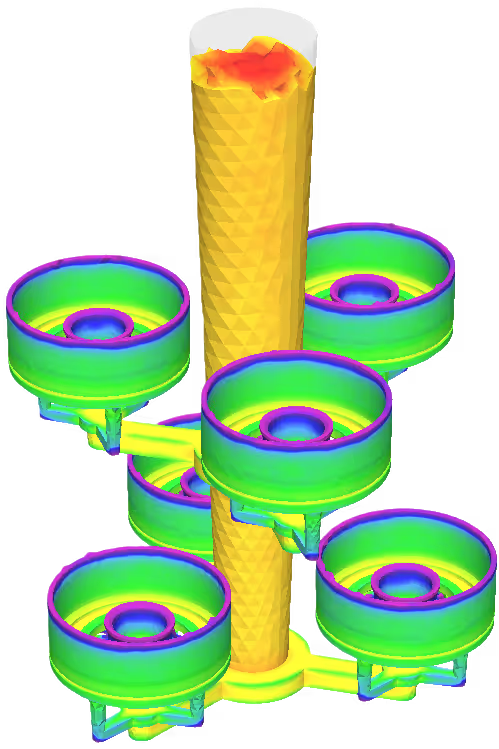
Analyze and resolve the root causes of defects in the design phase
Visualize and control every stage in your casting process
Replace slow and expensive physical trials with virtual prototyping


Are you facing problems with your cast parts, cracks and shells appearing, and don't know what's causing them?

Request a free simulation of your real casting to confirm that the model can predict defects
Not ready to buy the software yet? Request an analysis of your problem from our specialists.
%201.svg)
Get a full report on how to solve your problem at a very affordable price
Are you considering taking the next step and purchasing a commercial license for PoligonSoft?

Buy PoligonSoft with a perpetual license or subscribe for a year. Individual or network licenses available.
The genius of the pilot is that it never moralizes. It does not say the arranged date is bad and the forbidden attraction is good. It simply shows that Akiva is looking for a partner who sees his art as an answer, not a distraction. Esti sees a project to be fixed. Elisheva sees a mystery to be explored. No discussion of Shtisel 1x1 is complete without the Shabbos dinner scene. This is where the show’s theatrical roots (creator Yehonatan Indursky comes from the Haredi world) shine brightest. The family gathers: Shulem, Akiva, Giti, her many children, and the wayward Lippe. The lighting is warm. The challah is braided. And the air is thick with unspoken accusations.
The painting is not lewd. It is not even particularly romantic. It is a modest, melancholic portrait of a young redhead. But in the hyper-regulated visual economy of the Haredi world, where walls are bare of human faces (lest they lead to idolatry or, worse, desire), the painting is pornography. Giti is not angry about the money; she is wounded by the intention . Who is this woman? Is she a fantasy? A memory? Lippe, unable to articulate his longing, simply shrugs. "It’s beautiful," he says. For Lippe, the painting is a window; for Giti, it is a mirror reflecting her own inadequacy. Shtisel 1x1
The pilot introduces the central romance of the series with breathtaking economy. Akiva is pressured by his father to enter the shidduch (arranged dating) system. He is paired with a woman named Esti (Neta Riskin), a reserved, dark-haired teacher. The date is a disaster of awkward silences and forced smiles. But then, in the waiting room, Akiva meets her. The genius of the pilot is that it never moralizes
That is the first kiss. Not a physical kiss, but a spiritual one. In a world where men and women are forbidden from touching before marriage, a genuine glance is intimacy. Akiva walks away from his "proper" date completely unmoored, his head full of the widow’s smoke. Esti sees a project to be fixed
This is the first lesson of Shtisel : the dead are never absent. Rivka’s presence haunts the apartment, her photograph a silent third character in every family meal. Shulem is a man who has organized his life around the rigidity of Halakha (Jewish law) to avoid the messiness of emotion. But the pilot immediately challenges his fortress.
Her name is Elisheva (the luminous Ayelet Zurer). She is a widow, a mother, and she is smoking a cigarette with the casual grace of someone who has seen too much. She is also, crucially, not "in the parsha"—not actively looking to remarry. Their conversation lasts less than two minutes. She asks him why he draws. He says he doesn't know. She says, "That’s a good answer."
In the pantheon of prestige television, certain pilot episodes serve as a mission statement. The West Wing ’s walk-and-talk established a rhythm of power. Breaking Bad ’s underpants-clad Walter White established a thesis of transformation. But Shtisel —the Israeli drama about a Haredi (ultra-Orthodox Jewish) family living in the Geula neighborhood of Jerusalem—does something far more radical. Its pilot, “The First Kiss,” establishes a world where nothing explodes, no one yells, and yet every frame aches with the violence of suppressed desire.



The first version of the PoligonSoft casting simulation software, initially named SAM LP 'Poligon,' was developed in 1989 at the Central Research Institute of Materials (CIM, St. Petersburg) by order of the Ministry of Defense Industry.
It was the world's first commercial software package to implement a mathematical model for calculating microporosity. PoligonSoft has since been successfully adopted by aerospace industry enterprises, where stringent casting quality standards are required.
For over 30 years, the casting simulation software has continuously evolved, integrating extensive expertise and knowledge from leading institutes and numerous companies in Russia and abroad.
In July 2009, the PoligonSoft development team joined CSoft Development.


.svg)

.svg)