



product description

Not limited to a single theme framework, create 9 types of themes with different styles, there is always one that suits your taste!

Of course it's more than just looking good! When you drive on the road, you will find that the theme has rich dynamic effects, such as driving, instrumentation, ADAS, weather, etc., is it very interesting?

The shortcut icons on the desktop can be customized in style and function, and operate in the way you are used to!


product description
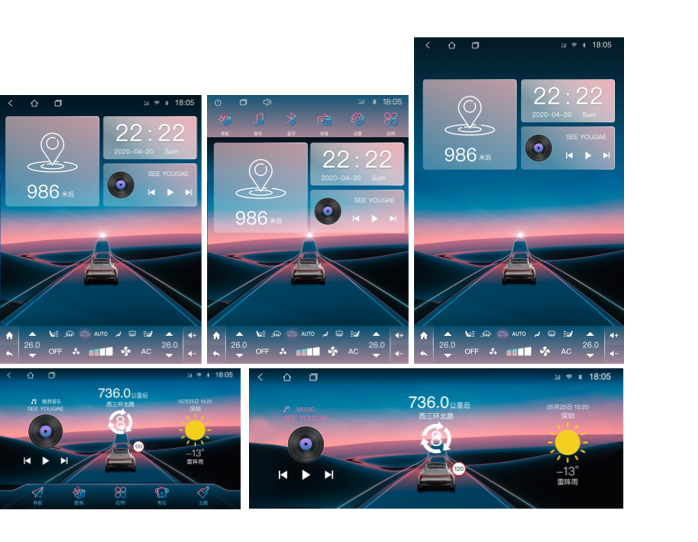
product description
Currently suitable resolutions are as follows:
Landscape contains: 1024x600、1024x768、1280x800、1280x480、2000x1200
Vertical screen includes: 768x1024、800x1280、1080x1920
If your car is different, it will use close resolution by default
Cars of Dingwei solution can use all the functions of the theme software, but some of the functions of cars of other solution providers are not available.

In addition to a single purchase, you can also


This paper analyzes the foundational contribution of Susan Solomon’s 1986 Nature article, “The Antarctic Ozone Hole: A Polar Stratospheric Cloud Chemical Mechanism” (often colloquially referred to as the foundational “Solomon PDF” in digital archives). We examine how Solomon’s model challenged the prevailing gas-phase chemistry paradigm by introducing heterogeneous reactions on Polar Stratospheric Clouds (PSCs). The analysis covers the paper’s methodology, its immediate falsification of the dynamical theory, its role in the Montreal Protocol, and its legacy as a template for crisis-driven atmospheric science. We conclude that the 1986 Solomon paper represents a quintessential example of a "small N, high impact" theoretical study.
Please reply with the full citation (e.g., “Solomon, J. (2003). PDF compression algorithms. IEEE Transactions.” ) or the actual PDF’s topic.
Below is a formatted for a journal like Environmental Research Letters or History of Science . Title: Paradigm Shift in Atmospheric Chemistry: A Retrospective Analysis of Susan Solomon’s 1986 “Nature” Paper (The “Solomon PDF”) Author: [Your Name] Affiliation: [Your University] Date: [Current Date]
By May 1985, the British Antarctic Survey’s Farman et al. had reported a 40% springtime ozone depletion over Halley Bay, a phenomenon dismissed by existing models as sensor error. The dominant theory held that chlorine chemistry occurred only in the gas phase, which could not account for the rapid destruction observed. Enter Susan Solomon’s 1986 theoretical paper—a three-page document now preserved as a canonical PDF in atmospheric science. This study reconstructs how Solomon’s PDF transformed an observational anomaly into a predictable chemical kinetics problem.
Weekly update






This paper analyzes the foundational contribution of Susan Solomon’s 1986 Nature article, “The Antarctic Ozone Hole: A Polar Stratospheric Cloud Chemical Mechanism” (often colloquially referred to as the foundational “Solomon PDF” in digital archives). We examine how Solomon’s model challenged the prevailing gas-phase chemistry paradigm by introducing heterogeneous reactions on Polar Stratospheric Clouds (PSCs). The analysis covers the paper’s methodology, its immediate falsification of the dynamical theory, its role in the Montreal Protocol, and its legacy as a template for crisis-driven atmospheric science. We conclude that the 1986 Solomon paper represents a quintessential example of a "small N, high impact" theoretical study.
Please reply with the full citation (e.g., “Solomon, J. (2003). PDF compression algorithms. IEEE Transactions.” ) or the actual PDF’s topic.
Below is a formatted for a journal like Environmental Research Letters or History of Science . Title: Paradigm Shift in Atmospheric Chemistry: A Retrospective Analysis of Susan Solomon’s 1986 “Nature” Paper (The “Solomon PDF”) Author: [Your Name] Affiliation: [Your University] Date: [Current Date]
By May 1985, the British Antarctic Survey’s Farman et al. had reported a 40% springtime ozone depletion over Halley Bay, a phenomenon dismissed by existing models as sensor error. The dominant theory held that chlorine chemistry occurred only in the gas phase, which could not account for the rapid destruction observed. Enter Susan Solomon’s 1986 theoretical paper—a three-page document now preserved as a canonical PDF in atmospheric science. This study reconstructs how Solomon’s PDF transformed an observational anomaly into a predictable chemical kinetics problem.